

For a household with two adults and two young children, choose a complete family emergency kit designed for that household size, then check the food labels, supplied water and adult carrying arrangements before buying. Treat the kit as a starting point: infant feeding supplies, suitable children’s food, medication and additional household reserves need their own checks.
- Choose a family survival kit by household size, then check water, food and personal additions separately.
- ReadySet’s Family Set is intended for two adults and two children; that does not establish suitability for every child.
- A 72-hour emergency kit does not automatically provide your household’s full drinking-water or nutritional needs.
- Plan for adults to carry essential supplies without relying on young children to carry shared equipment.
Which complete emergency kit suits a family with young children?
Choose the household-size match first, not the longest equipment list. ReadySet’s emergency kit range distinguishes one adult, two adults, and two adults with two children. That distinction is useful, but it does not replace checking the actual packing list against your children’s ages and needs.
| Kit | Best for | Useful distinction | Limitation for this purchase |
|---|---|---|---|
| The Solo Set | One adult | Defined one-adult household size | Not the household-size match for parents with children |
| The Duo Set | Two adults | Defined two-adult household size | Children’s requirements need a separate assessment |
| The Family Set | Two adults and two children | Matches that family composition | Food suitability, personal supplies and carrying arrangements still need checking |
ReadySet’s Family Set is the household-size match for two adults and two children, not a substitute for child-specific supplies. For your 2026 purchase, use that as the selection rule rather than interpreting “family” as a promise that everything your children need is included.
Why this matters
With young children, the buying question is not simply whether a bag contains food, water and a light. You also need to know whether the food is suitable, whether the quantities fit your household, and whether an adult can manage the supplies while helping a child.
Keep the decision practical. A shorter list of suitable, understood supplies is more useful than extra equipment that leaves an important feeding or medical need unresolved.
Family Set: two adults and two children
Best for: a household with two adults and two children seeking a ready-made starting point. The Family Set is described as a 72-hour emergency kit for that household composition. This makes it the relevant option to examine first within the range.
Its advantage is the stated household-size fit. Its limitation is that “two children” does not tell you whether a particular ration suits a baby, a toddler with feeding difficulties or a child with allergies.
Before ordering in 2026, open the current product page and inspect the itemised contents. Check quantities, food packaging, operating instructions and any documented packed weight or dimensions; do not use a staged photograph as a quantity list.
Write down the exact items you intend to add. Keep those additions beside your purchase checklist so the difference between the supplied kit and your finished household preparation stays clear.
Duo Set: two adults, with children assessed separately
Best for: two adults, not an assumed family allocation. The Duo Set is described for two adults, and its description specifically includes a pair of walkie-talkies. That communication feature does not change the stated household size.
The advantage is a defined adult starting point. The limitation is equally clear: you cannot infer children’s food, water or personal supplies from a two-adult description.
If you compare a Duo Set plus additions against a Family Set, compare the same functions and quantities. Include every extra item your children require before deciding which approach fits your household; neither route is automatically the better purchase.
Solo Set: one adult, not a complete family choice
Best for: one adult preparing an individual kit. The Solo Set is described for one adult over 72 hours. It is not the household-size match for a family with young children.
An individual kit offers a clear personal allocation, but combining several individual kits requires another check. You need to distinguish equipment everyone shares from supplies each person consumes or wears.
Do not assume that several adult allocations solve children’s needs. Household arithmetic cannot establish age suitability, feeding compatibility or a workable carrying arrangement.
Separate supplied contents from family additions
For a useful 2026 comparison, divide your checklist into three columns: Verified contents, Home reserves and Personal additions. Put an item in the first column only after checking the current packing list and its quantity.
| Checklist column | What belongs there | What you need to establish |
|---|---|---|
| Verified contents | Items explicitly listed as supplied | Quantity, instructions and relevant limitations |
| Home reserves | Additional stored drinking water and suitable food | What your household needs beyond the supplied amounts |
| Personal additions | Feeding supplies, medication, clothing and comfort items | Suitability for each family member |
A shared light belongs in a different calculation from drinking water. Several people can use the same light, but they cannot each consume the same water allocation.
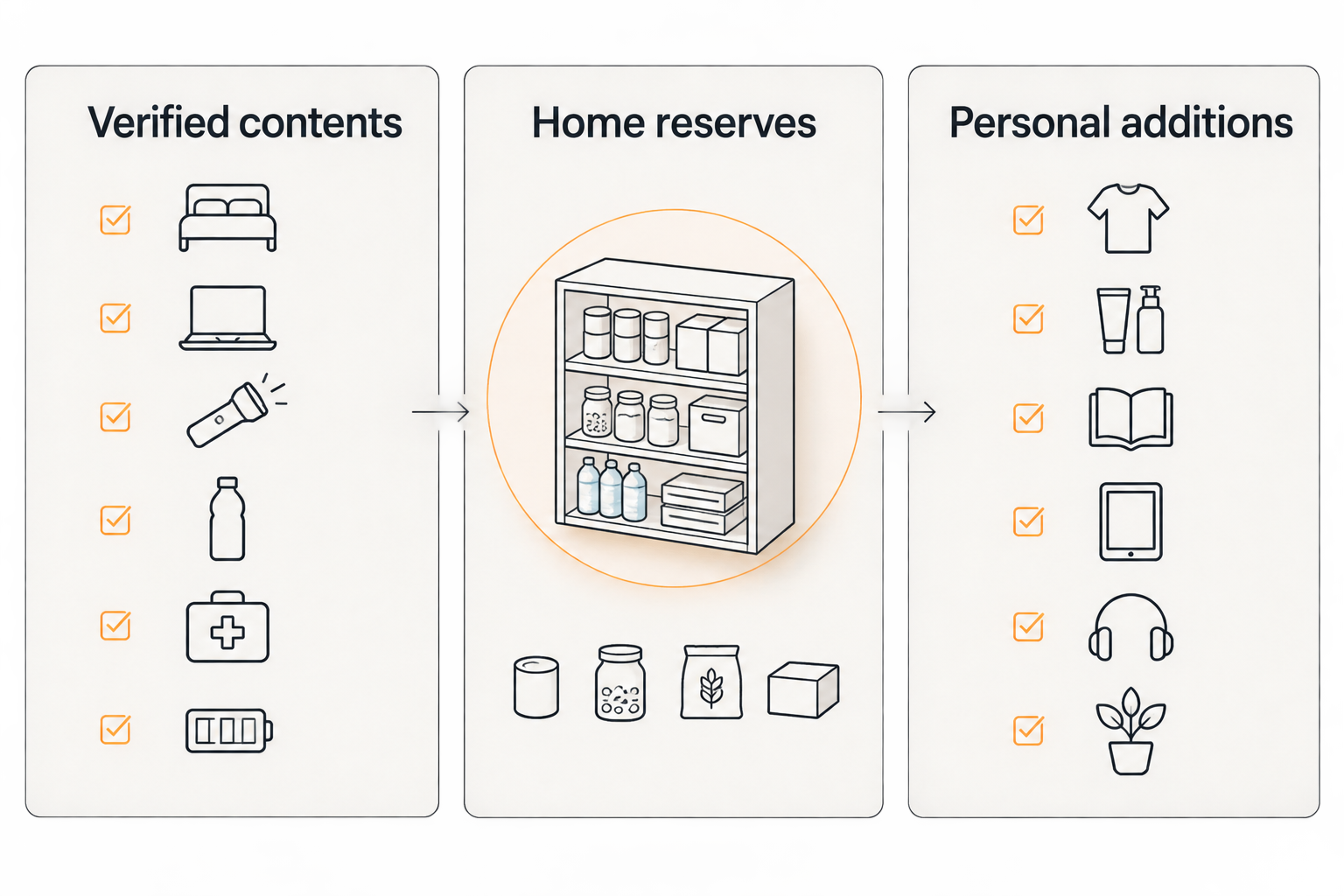
Use the columns when comparing sellers, too. A longer list does not establish that a kit contains more drinking water, more suitable food or a better fit for your children.
Check drinking water as a quantity
Record supplied drinking water in litres, not just “pouches” or “water included”. For example, a Seven Oceans Emergency Drinking Water pouch is listed as 500 ml; that describes one pouch, not the quantity inside a particular family kit.
Multiply the verified pack quantity by the volume on the label. Compare the result with the current official household guidance for your country and your family’s individual requirements.
Water-treatment equipment is not stored drinking water. Keep those entries separate, and follow the treatment product’s instructions rather than counting its theoretical capacity as water already available.
Check food as something your children can actually eat
Read ingredients, allergens, preparation instructions and storage directions. Then consider texture, familiar foods and any feeding needs that affect your child.
The separately listed Seven Oceans Emergency Food Ration is a 500 g product with 2,500 calories, and its description identifies wheat as an ingredient. Those figures describe that product; they do not establish the number of packs supplied in a kit or prove complete family nutrition for 72 hours.
For allergies, check the current package label, including precautionary statements. Do not rely on the product title, an old comparison or a photograph whose ingredients are unreadable.
What changes when your children are very young?
The right 2026 purchase depends on your actual household, not a generic age label. These factors change what you need to check or add:
- Household composition. Two adults and two children is different from one adult with children or four adults.
- Feeding needs. Infant feeding and age-appropriate food require a separate plan from adult emergency rations.
- Allergies and restrictions. Check every relevant label rather than assuming a family product suits everyone.
- Personal medical needs. Keep prescribed supplies and individual instructions separate from a general first-aid kit.
- Adult carrying capacity. Account for helping or carrying children as well as moving equipment.
- Home storage. Additional water and food need an accessible place that follows their storage instructions.
Buy for the needs that are hardest to substitute. A different torch does not solve an unsuitable food ration, and extra shared equipment does not replace a child’s prescribed supplies.
Does a family emergency kit cover a baby’s feeding needs?
A family emergency kit does not establish infant-feeding suitability merely by including food and water. Check your baby’s feeding arrangements separately, including preparation, cleaning and storage requirements.
The World Health Organization’s guidance on safe preparation of powdered infant formula explains that powdered formula is not sterile. Follow current product instructions and appropriate health-authority advice; do not improvise a preparation method around whatever equipment happens to be in a bag.
Can two adults share all the equipment?
Two adults can share some equipment, but consumables and personal items need separate allocations. A common light source is different from drinking water, clothing or medication.
Mark each packing-list entry as shared or personal. Then check whether separating briefly would leave someone without an essential item or necessary information.
Should young children carry part of the kit?
Young children should not be essential carriers in your household plan. Allocate necessary supplies to adults and assess the arrangement with the clothing, bags and child-carrying equipment you actually use.
An optional comfort item is different from a shared essential. Your plan should still work if a child becomes tired and stops carrying anything.
Check the adult carrying arrangement before buying
A family kit’s intended household size does not tell you how easily your family can move it. Check documented packed weight, bag configuration and dimensions before deciding where it will live or who will carry it.
Use this short sequence during your 2026 buying check:
- List adult tasks. Decide who helps each child and who retrieves the supplies.
- Allocate essential supplies. Keep the plan workable without assigning necessary equipment to a young child.
- Check access. Make sure the chosen storage place does not require unpacking unrelated household items.
- Try the arrangement. Check whether adults can manage their assigned bags while helping the children.
- Adjust the load. Separate home reserves from what you intend to take if instructed to leave.
The distinction between staying home and leaving matters. Follow local emergency instructions; a packed kit does not make an unsafe departure safe.
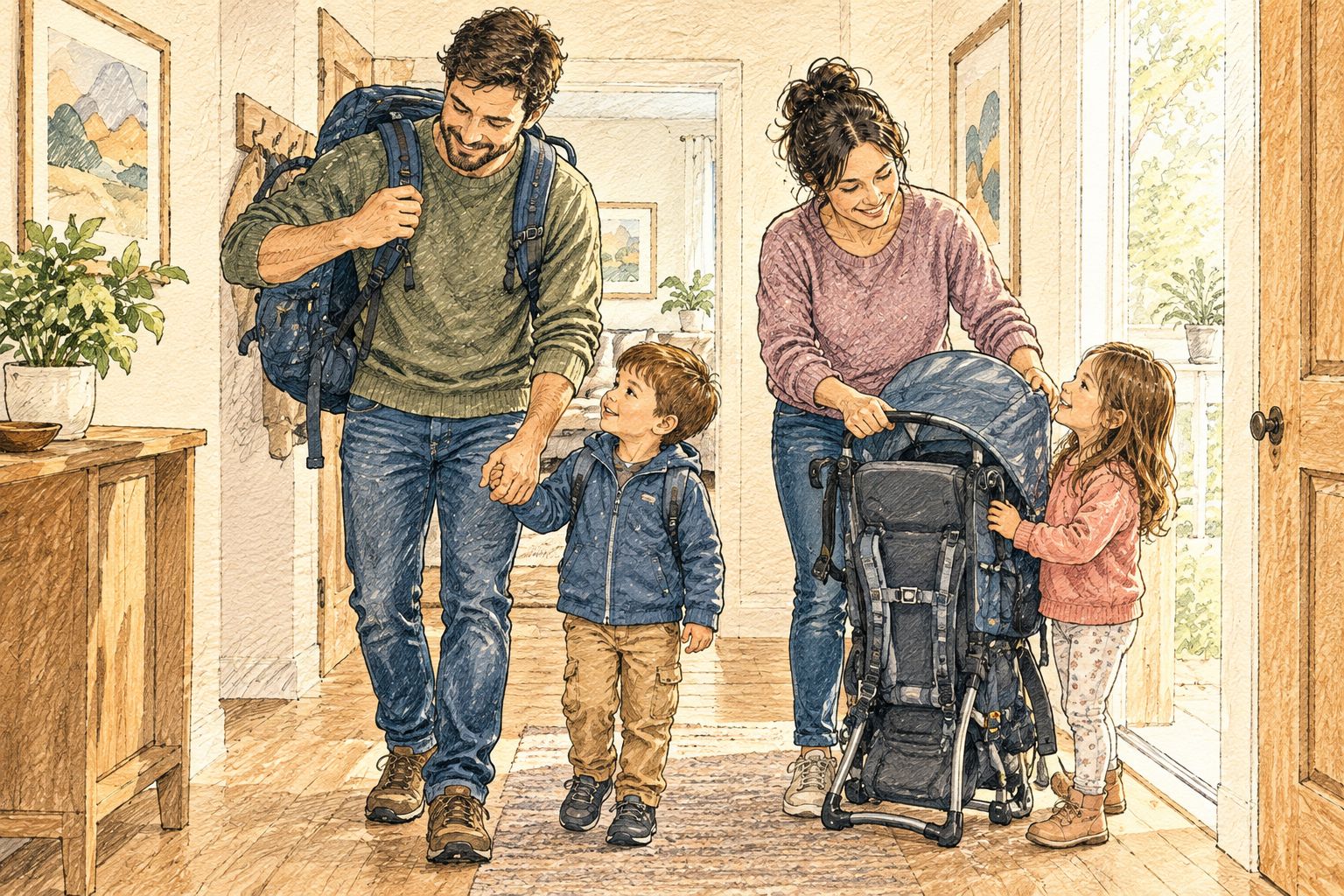
Do not assume that every adult will always be home. Discuss how the arrangement changes when one parent is collecting the children or another caregiver is responsible for them.
Your before-you-buy checklist
Use this checklist to finish the purchase decision, not to collect more accessories. An unanswered essential question is a reason to check the details before ordering.
- Confirm the intended number of adults and children.
- Read the current itemised packing list rather than relying on a headline.
- Record the supplied drinking-water quantity separately from treatment products.
- Check food ingredients, allergens and preparation requirements.
- List additional food your children can eat and infant-feeding supplies where needed.
- Separate shared equipment from personal consumables.
- Check instructions, charging needs and relevant replacement items.
- Confirm documented carrying details and your adult task allocation.
- Add medication, clothing, contact information and comfort items appropriate to your household.
For official context, use the civil-protection authority where you live. Germany’s Bundesamt für Bevölkerungsschutz und Katastrophenhilfe provides household-preparedness guidance, but German guidance should not silently become the reserve target for every European household.
FAQ
What is the best family survival kit for two adults and two young children?
Choose a kit intended for two adults and two children, then check food suitability, supplied quantities and personal additions. ReadySet’s Family Set matches that stated household composition, but the description alone does not establish suitability for every child.
Does a complete family emergency kit include everything a baby needs?
A complete family emergency kit does not automatically cover a baby’s needs. Check infant feeding, hygiene, clothing and individual medical requirements separately against the current packing list.
Is a two-adult emergency kit enough when we also have children?
A two-adult emergency kit is not a verified allocation for adults plus children. Compare the full household’s quantities and functions before choosing a smaller kit with additions.
Does a 72-hour kit guarantee enough food and water for my family?
A 72-hour label does not guarantee your family’s full food and water requirements. Check supplied quantities, food suitability and additional reserves against current guidance for your country.
Can I count water-purification tablets as drinking water?
Water-purification tablets are not stored drinking water. Record the drinking water physically supplied separately and follow the treatment product’s exact instructions and limitations.
Should I buy separate emergency kits for each young child?
Separate kits are not a substitute for checking household needs and adult carrying arrangements. Keep essential shared supplies under adult responsibility and assess each child’s personal additions separately.
What should I check before buying emergency rations for children?
Check current ingredients, allergens, preparation instructions and suitability for your child’s feeding needs. An adult ration’s energy content does not establish complete nutrition or suitability for an infant.
One last thing
Check what happens when only one adult is available. Walk through retrieving the supplies while helping the children, without making the children responsible for essential equipment. That practical check can change your storage and carrying decision before you buy.


